
SEO
SEO for small businesses: what it is and why it matters
Most small business owners know they are supposed to care about SEO. Far fewer have ever had it explained in a way that makes sense, without a sales pitch wrapped around it. So here is the plain version: what search engine optimisation is, why it earns its place in your marketing, and the on-page work that does most of the heavy lifting.
None of it is magic, and a good deal of it is within your control.
What SEO actually is
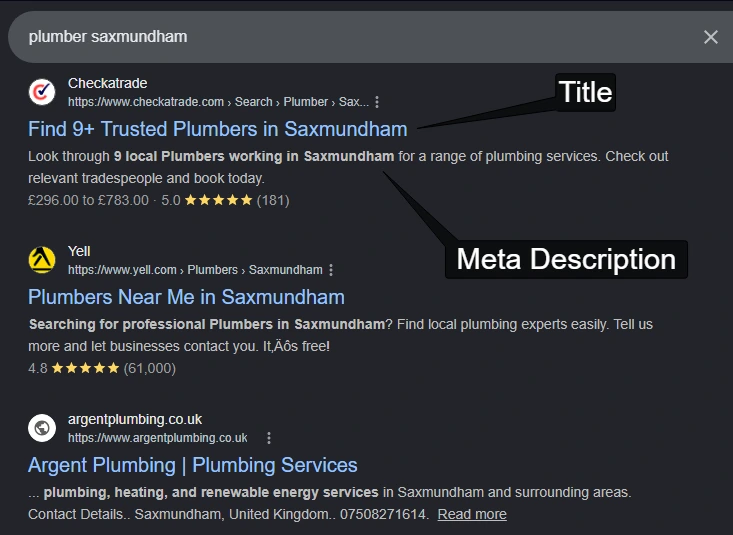
When someone searches for an emergency plumber or a wedding photographer, Google shows them a ranked list of pages it thinks will answer the question best. SEO is the work of earning a spot near the top of that list for the searches your customers are actually typing. The results below the ads are the organic ones, and they pull in the bulk of the clicks because people trust them more than anything with “Sponsored” next to it.
Google decides that order by reading your pages the way a very literal, very impatient reader would, and by checking how the rest of the web treats you. Get both sides right and you show up at the moment someone wants what you sell. Get them wrong and you stay invisible to people who are trying to spend money with a business like yours.
Why it matters when you are small
Big companies can buy their way to the top of the page with ads all day long. Most small businesses cannot, at least not forever. Search visibility you have earned keeps working after you stop paying for it, which is the opposite of how advertising behaves the second your budget runs dry.
There is an honest caveat. SEO is slow. You are unlikely to see much in the first couple of months, and anyone promising you the top spot by Friday is either lying or about to get your site penalised. What you are building is a position that compounds: a page ranking well this quarter tends to gather the links and clicks that help it rank better next quarter. For a local business in particular, a few well-optimised pages can keep bringing in enquiries for years.
Search visibility you have earned is the cheapest marketing a small business has, once it finally starts working.
On-page SEO: the part you actually control
SEO splits roughly into two halves. Off-page is everything that happens elsewhere, such as other websites linking to you, your Google Business Profile, reviews, and mentions dotted around the web. On-page is everything on your own site, which is the half you can fix this afternoon without waiting on anyone else. It is also the half most small business sites get wrong.
Start with your page titles. The title tag is the clickable blue headline that shows up in Google, and it carries real weight both for ranking and for whether anyone bothers clicking. A page titled “Home” tells Google and the searcher nothing useful. “Emergency Plumber in Saxmundham | Smith and Sons” tells them exactly what you do and where, which is what someone with a burst pipe needs to see at a glance.
Sitting underneath that is the meta description, the short paragraph of grey text below the title. It does not directly affect your ranking, but a clear and specific one earns more clicks, and click-through is something Google pays attention to. Treat it like ad copy and give people a concrete reason to choose your result.
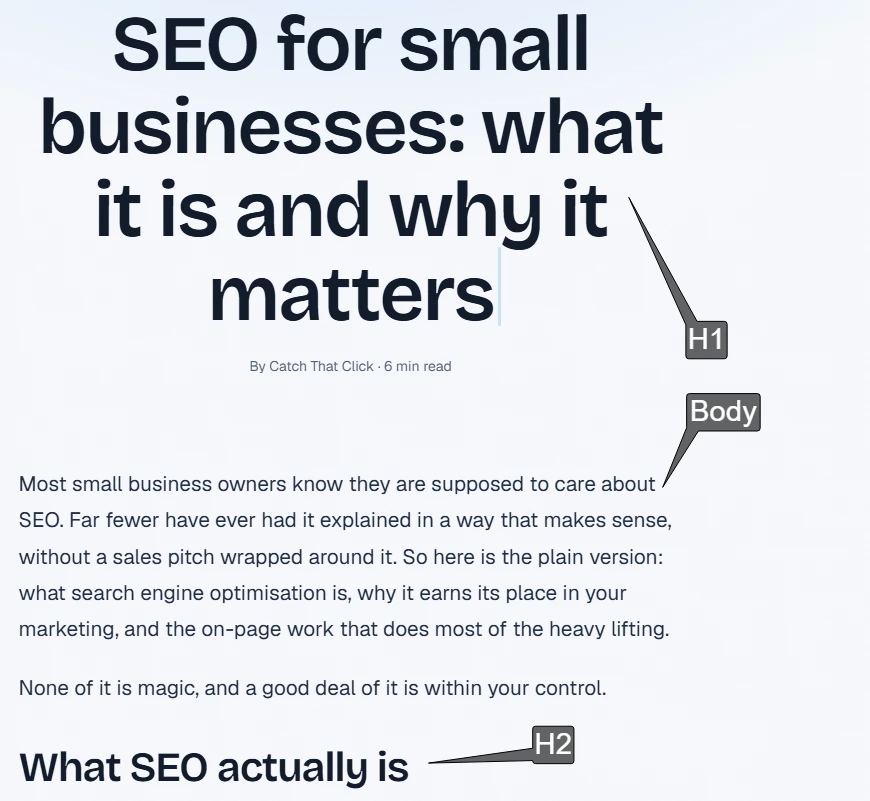
Each page also needs one main heading, the H1, saying plainly what the page is about. Your sub-headings, the H2s and H3s, break the page into readable sections, and they happen to be a sensible place to use the words people search for. If customers keep asking about “fixed-price boiler servicing”, that phrase belongs in a heading, not lost somewhere in paragraph nine.
Then there is the copy itself. This is where owners tend to either ignore keywords completely or jam them in until the writing reads like a robot produced it. Neither works. Write naturally, for a person, and make sure the words your customers use appear where they would expect to find them. If everyone locally calls it a “man and van” service and your website only ever says “logistics solutions”, you have quietly optimised yourself out of the search.
Link your own pages together while you are at it. When your boiler-servicing page links through to your emergency-callout page using clear words for the link, you help Google understand how the site fits together and you nudge visitors toward making an enquiry. Images matter here too, and they wreck two things at once when neglected. A photo straight off a phone can weigh several megabytes, which slows the page down, and page speed feeds directly into ranking. Every image wants a short piece of alt text as well, partly for accessibility and partly because it is one more honest signal of what the page is about. Even your web addresses pull their weight: /services/bathroom-fitting reads better to a person and to a search engine than /page-id-4471.
What is not worth your time
Plenty of SEO advice online is either out of date or written to sell you something. Some of it you can safely ignore. The meta keywords tag has done nothing for over a decade. Buying cheap backlinks is a fast route to getting your site demoted. Watching your exact ranking position every single day will drive you up the wall, because it shifts constantly and depends on who is searching and where they are sitting. Put that energy into writing genuinely useful pages about the work you do, and into getting real customers to leave real reviews. It is the boring answer, and it is also the one that holds up.
Where a small business should start
If you do nothing else, sort out your page titles and make sure every important page targets one clear thing a customer might search for. After that, write a solid page for each main service or area you cover, in plain language, answering the questions you already get asked on the phone. The work is unglamorous and it pays off slowly, but it does pay off.
We build this thinking into every website we make, so the technical groundwork and the on-page basics are in place before you write a single word. If you would rather not wrestle with title tags and headings yourself, that is a perfectly reasonable thing to hand over, and it is a large part of what we do.