
Performance
Why website speed matters, and what slows your site down
A visitor lands on your website, waits a second or two while not much happens, and clicks back to a competitor before your homepage has finished loading. They will not email to tell you they did this. You simply never hear from them, and you have no idea it happened. That is the quiet problem with a slow site.
Speed is the part of a website nobody compliments and everybody notices. When it is good, it goes unseen. When it is bad, people leave.
What page speed actually means

Page speed covers a few different things: how quickly the first content shows up, how soon someone can actually use the page, whether the layout jumps around as images load in, and how fast the page responds when they tap something. Google groups the parts it cares about into what it calls Core Web Vitals, and you can check any page for free with its PageSpeed Insights tool. Type in your web address and it grades you, usually more harshly than you would like.
The score on its own matters less than what it points at. A page sitting in the red on a mid-range phone is losing you real customers, whatever it looks like on the shiny laptop in your office.
Why a slow site costs you customers
People have very little patience online, and they have even less of it on a phone. Test after test has found the same thing: the longer a page takes to load, the more visitors give up before it appears. For a café taking bookings or a tradesperson sending quotes, every one of those drop-offs is money that walked back out the door. You paid to get that person to your site, whether in ad spend or in the hours you put into being found, and a slow page threw it away at the last step.
Google cares too, and it is open about why. Its whole job is to point people at pages that give them a good experience, and a sluggish page does not. Speed sits among the on-page factors it rewards, alongside the titles, headings and content basics covered here. A slow site is harder to find and less likely to win over the people who do find it, which is a rough combination when you are working with a small marketing budget.
A good-looking website that loads slowly is a shop with a beautiful window display and a door that sticks.
What actually slows a small business site down
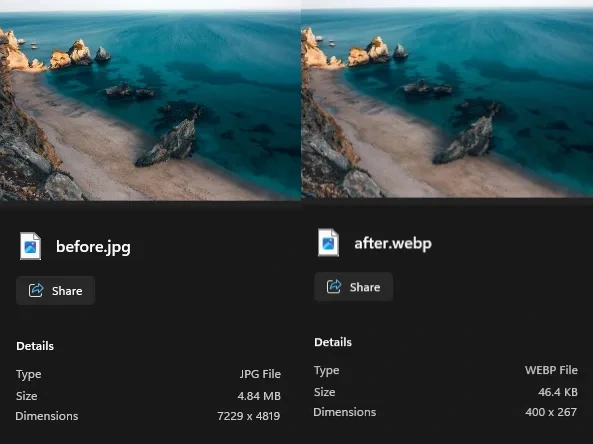
Most slow websites were not built slow on purpose. They get heavy over time, and a handful of culprits turn up again and again.
Images are nearly always the biggest one. A photo straight off a modern phone can weigh four or five megabytes, and a page carrying ten of them at full size will crawl over mobile data. Resized and compressed properly, those same photos look identical to a visitor and take up a fraction of the space.
Hosting is the next suspect. The bargain shared plans that cost a couple of pounds a month often cram thousands of websites onto one overworked server, so yours slows to a crawl whenever a neighbour has a busy day. You do not need anything pricey, but rock-bottom hosting usually shows.
Then there is the way the site is put together. Drag-and-drop page builders are popular because they look effortless in the demo, and they are very often the reason a site is bloated, because they ship piles of code your page never actually uses. Add a heavy theme on top, install a dozen plugins, and bolt on every third-party script someone once recommended (live chat, analytics, a cookie banner, a couple of font services), and the browser ends up doing far more work than your actual content calls for.
None of this is the owner’s fault. It is what happens when a site is assembled from convenient parts instead of being built with its weight in mind.
How to tell whether yours has a problem
Do not trust how the site feels on your own computer. You are on fast broadband, your browser has the site saved from last time, and you already know where everything is. Open it on your phone on mobile data instead, somewhere with a patchy signal if you can, and time how long you spend looking at a blank or half-built screen. Then put the address through PageSpeed Insights for an outside opinion. Between your own thumb and that report, you will find out fast whether speed is quietly costing you.
What good looks like, and where to start
A fast site is mostly the product of decisions made early: lean code, images served at the right size, hosting that can cope, and very little that the page does not genuinely need. Bolting speed onto an already bloated site can be done, but it tends to be slower and more aggravating than building it right the first time, which is the honest reason we usually suggest a rebuild when a site is badly weighed down rather than papering over it.
When we build a website, we treat speed as a requirement from the first day rather than a tweak at the end. We aim for a PageSpeed score in the nineties on an ordinary phone, compress every image, and keep the code to what the page truly uses. If your current site feels slow, it is worth a proper look, because the fix is often less dramatic than you fear, and your customers will feel the difference straight away even if they never quite work out why.